

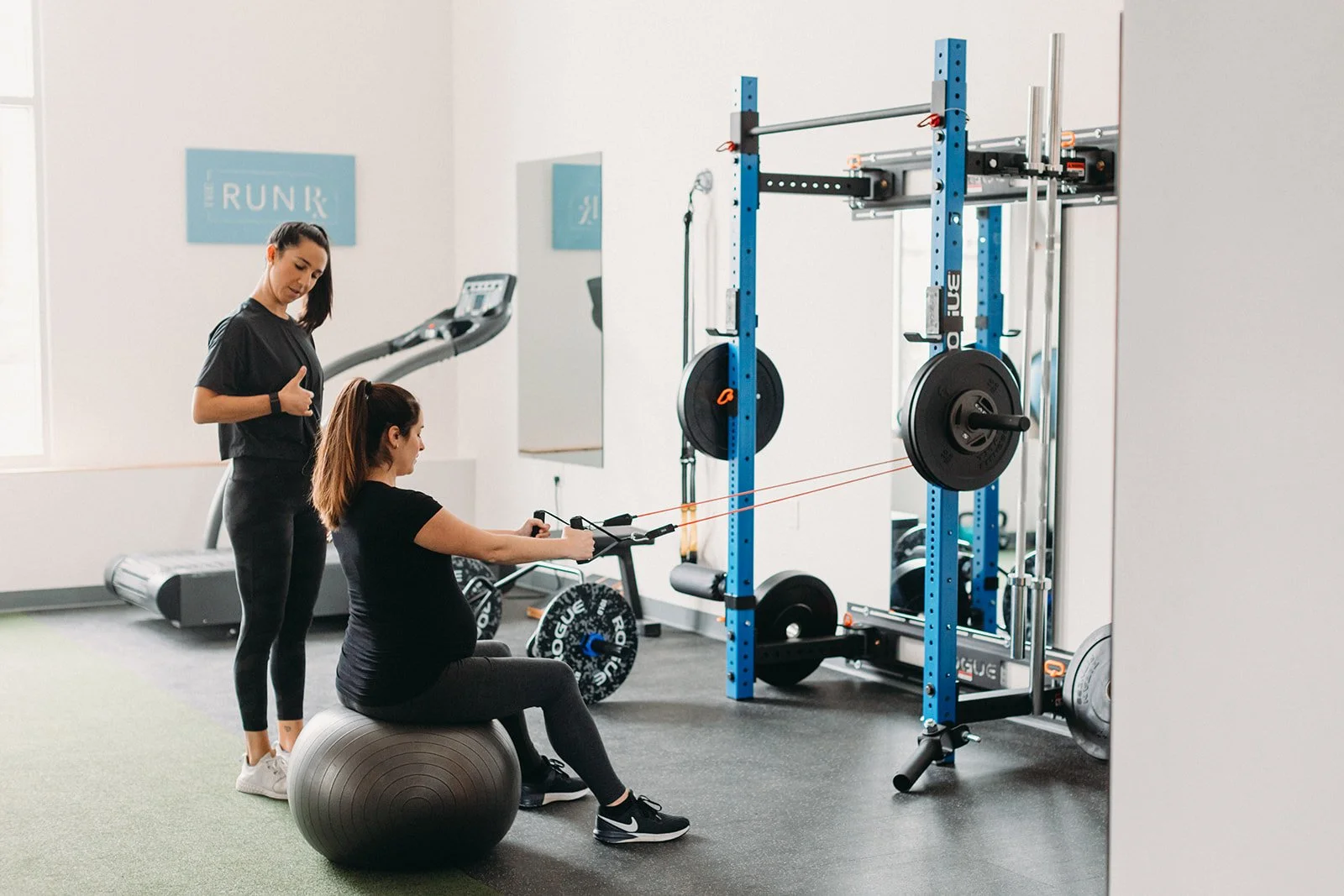
If you’ve ever been told to “just rest,” “avoid abs,” “stop running,” or “wait until everything feels normal again,” you’re not alone.
Pregnancy and postpartum fitness are full of outdated advice, fear-based messaging, and confusion — especially for active women who want to keep running, lifting, strength training, taking fitness classes, training for HYROX, playing pickleball, or simply moving in a way that makes them feel like themselves.
At The Run Rx in Somerville, we’re here to change that.
Pregnancy and postpartum are not injuries. But they are major physical transitions, and active women deserve better than vague rules, blanket restrictions, or being told to stop doing the things they love without a real plan.
Whether you’re pregnant, newly postpartum, returning to running, getting back under a barbell, rejoining your favorite workout class, building back toward a race, or trying to feel confident moving through daily life again, the goal is not to scare you away from movement. The goal is to help you move with more confidence, clarity, and support.
As a physical therapy and performance clinic serving active women across Somerville, Boston, Cambridge, Medford, and the greater Boston area, we help pregnant and postpartum athletes understand what is safe, what needs to be modified, and how to keep building strength through every season.
Below, we’re answering some of the most common questions we hear about exercising during pregnancy and postpartum.
Is exercise during pregnancy dangerous?
Nope. In fact, it’s incredibly beneficial.
As long as your provider hasn’t given you specific restrictions, exercise is not only safe — it’s recommended.
Research shows that staying active during pregnancy can help:
Reduce back and pelvic pain
Improve energy and mood
Support better labor and delivery outcomes
Lower the risk of gestational diabetes and preeclampsia
Maintain strength and cardiovascular fitness
Support a smoother return to activity postpartum
That does not mean every workout should look exactly the same as it did before pregnancy. Pregnancy-related exercise considerations still matter.
You may need to modify based on comfort, symptoms, trimester, fatigue, pelvic floor response, and overall recovery. It’s also important to avoid excessive heat, prioritize hydration, and make sure you’re fueling enough to support both pregnancy and activity.
The big takeaway: exercise during pregnancy is not something to fear. It is something to approach thoughtfully.

Do ab exercises cause or worsen diastasis recti?
No — ab exercises do not automatically cause or worsen diastasis.
In fact, core exercises can be helpful in managing diastasis and setting you up for an easier postpartum recovery.
While we’re talking diastasis, let’s bust a myth really quick: diastasis recti is not your abdominal muscles “splitting apart” in a scary or permanent way. It is a stretching of the connective tissue between the two sides of the six-pack muscle. This is a perfectly normal and healthy adaptation during pregnancy and often lingers into the postpartum period.
Diastasis recti is influenced by multiple factors, including:
Hormonal changes
Tissue adaptability
Pressure management
Genetics
Overall strength and coordination
Rather than skipping abs entirely, the goal is to learn how to manage pressure and rebuild strength progressively.
Focus on:
Exhaling and bracing during the more challenging portion of an exercise
Choosing core exercises that match your current capacity
Building strength gradually over time
Watching how your body responds instead of fearing every core movement
Your core is not off-limits during pregnancy or postpartum. It just deserves smart training.

What do I do if I see doming or coning?
No worries!
Doming, also called coning, is common to see during pregnancy and the postpartum period due to diastasis recti. It happens when the connective tissue between the six-pack muscles pushes outward during movement or effort.
Many people used to believe — and some still do — that if doming occurs, it automatically worsens diastasis. However, researchers have not been able to find evidence that this is the case.
Our advice if you’re seeing doming/coning:
No need to panic
While it likely won’t make diastasis worse, it can be a sign that an exercise is getting too challenging
Modify as needed and focus on exercises where you can maintain inward tension throughout the entire core
Sometimes that means changing the position. Sometimes it means reducing load. Sometimes it means adjusting your breathing, tempo, range of motion, or exercise choice.
Doming is not a reason to fear movement. It is simply information.
Should I avoid exercise if I have leaking, pressure, or heaviness?
Not necessarily!
None of these symptoms are inherently dangerous. However, they are most certainly not something you need to deal with. If you’re experiencing any of these symptoms, we recommend seeking pelvic floor PT, where your PT can help you make a plan for managing symptoms during exercise.
Should I wait until everything feels “normal” before exercising?
Nope. Waiting often delays recovery.
There is no single moment where everything suddenly feels “back to normal.” And honestly, for many women, postpartum recovery is less about getting back to your old body and more about learning how to build strength, confidence, and capacity in the body you have now.
Strategic, guided movement can help you:
Restore strength sooner
Improve symptoms
Rebuild confidence in your body
Reconnect with your core and pelvic floor
Improve tolerance to running, lifting, and daily demands
Feel more like yourself again
The goal is to meet your body where it is, rather than waiting for perfection.
This might mean starting with breath work, mobility, walking, bodyweight strength, light resistance, or foundational core exercises. It might also mean progressing toward heavier strength training, running, jumping, and sport-specific work over time.
Movement is not something you earn only after you feel perfect. It can be part of the process that helps you feel better.
When can I return to running postpartum?
This is one of the biggest questions we hear — and the answer is not simply “six weeks.”
Being cleared at your six-week appointment usually means there are no major medical concerns. That is important, but it is not the same as being physically prepared to run.
Running is a high-impact activity. It requires strength, pelvic floor coordination, core control, single-leg stability, calf capacity, and the ability to absorb repeated impact.
Before returning to running postpartum, we want to consider:
Pelvic floor symptoms
Leaking, pressure, or heaviness
Pain
C-section or perineal healing
Core control
Single-leg strength
Impact tolerance
Sleep and recovery
Training history
Current stress and daily demands
Some women may feel ready earlier than others. Some need more time. That does not mean you are behind. A smart return-to-running plan should be based on readiness, not just a date on the calendar.
Can I lift heavy postpartum?
Eventually, yes — heavy lifting can absolutely be part of postpartum recovery and long-term strength.
But like running, lifting should be progressed.
The question is not just, “Can I lift this weight?”
The better questions are:
Can I manage pressure well?
Do I have symptoms during or after?
Can I recover from this session?
Does my current strength support this load?
Am I progressing gradually enough?
Heavy lifting is not the enemy. Poor progression, unmanaged symptoms, and jumping back too quickly are usually the bigger issues. We want postpartum women to feel strong again — not afraid to pick up a barbell, kettlebell, stroller, car seat, or growing toddler.
The Bottom Line
Pregnancy and postpartum do not mean you have to stop moving.
You can keep exercising during pregnancy.
You can train your core.
You can modify without quitting.
You can rebuild before everything feels perfect.
You can return to running and lifting with a plan.
You can ask for help before things feel completely off track.
The goal is not to do everything the same.
The goal is to understand what your body needs now, build strength progressively, and keep moving in a way that supports your health, your goals, and your life.
At The Run Rx, we help pregnant and postpartum active women navigate running, lifting, strength training, symptoms, and return to exercise with clarity and confidence.
If you’re pregnant, postpartum, or planning ahead and want support from providers who understand active women, we’d love to help.
Learn more about our perinatal offerings or book an evaluation today.