

Rearfoot Strike vs Forefoot Strike: Is Heel Striking Really Bad for Runners?

When it comes to running form, few topics spark more debate than footstrike pattern.
Many runners have been told that heel striking is inefficient, increases injury risk, and should be corrected. Forefoot striking, on the other hand, is often portrayed as the "better" way to run.
But does the science support that claim?
The short answer: not really.
Current research suggests that rearfoot striking isn't inherently bad. In fact, most runners—including many elite marathoners—naturally land on their heels. While footstrike pattern influences how forces are distributed throughout the body, there is little evidence that one strike pattern is universally superior for performance or injury prevention.
At our clinic, we frequently perform running gait analysis for runners in Somerville and Boston who are concerned about their running form, footstrike pattern, or recurring injuries. One of the most common questions we hear is, "Am I getting injured because I heel strike?" While footstrike certainly influences running mechanics, the research suggests the answer is more nuanced than many runners realize.
Whether you're training for the Boston Marathon, running along the Charles River, or logging miles through Somerville's community paths, understanding how your body absorbs and distributes force can help you make more informed decisions about your training.
What Is Footstrike Pattern?
Footstrike pattern refers to the part of the foot that contacts the ground first during running.
Forefoot Strike (FFS)
A forefoot strike occurs when the ball of the foot lands first.
Compared to rearfoot striking, forefoot striking typically:
Increases Achilles tendon and calf loading
Increases leg stiffness
Reduces knee loading
Relies more on elastic energy return from the ankle complex
Midfoot Strike (MFS)
A midfoot strike occurs when the heel and forefoot contact the ground at nearly the same time.
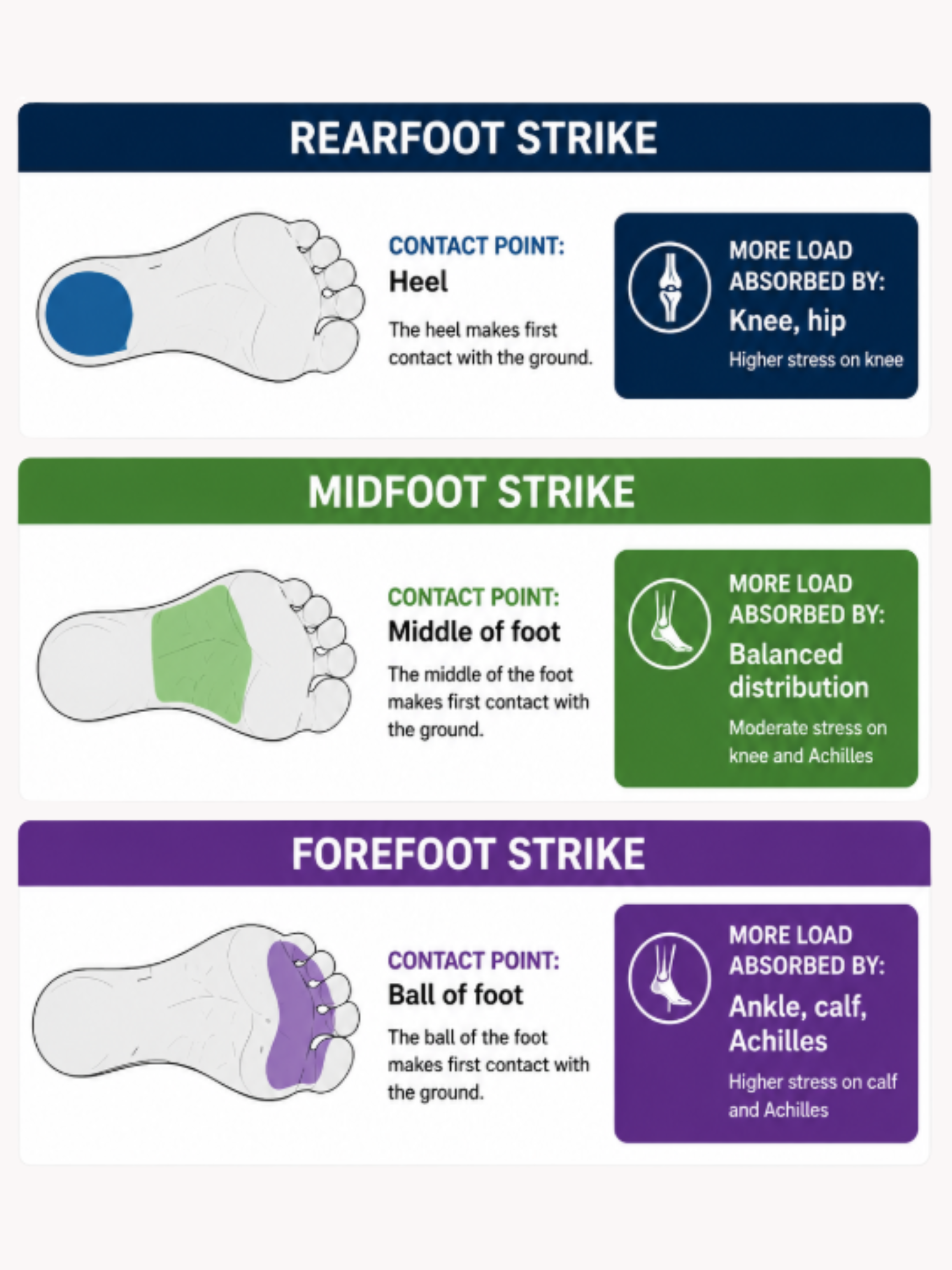
Rearfoot Strike (RFS)
A rearfoot strike occurs when the heel lands first.
Compared to forefoot striking, rearfoot striking typically:
Places greater load on the knee
Produces longer ground contact times
Reduces stress on the Achilles tendon and calf musculature
Most Runners Are Rearfoot Strikers
Despite the popularity of forefoot striking discussions, rearfoot striking remains the most common running pattern.
A study examining athletes at the 2017 IAAF World Championships Marathon found that rearfoot striking was the dominant pattern throughout the race. At every checkpoint, at least 54% of men and 67% of women were rearfoot strikers. Notably, the top four male finishers all landed with a rearfoot strike pattern.
If heel striking was inherently inefficient, we'd expect elite marathoners to avoid it. The evidence suggests otherwise.
Footstrike Doesn't Eliminate Injury Risk—It Redistributes It
One of the biggest misconceptions in running is that changing footstrike will prevent injuries.
Research consistently shows that changing footstrike primarily changes where forces are absorbed.
Forefoot Strike May Reduce Knee Stress
Forefoot striking has been shown to:
Reduce patellofemoral joint stress
Lower knee loading
Increase ankle energy absorption
This is one reason some clinicians use forefoot strike retraining for runners with persistent anterior knee pain.
But It Increases Stress Elsewhere
The tradeoff is increased loading on:
The Achilles tendon
Calf muscles
Plantar fascia
Metatarsals
This may increase susceptibility to conditions such as Achilles tendinopathy, plantar fasciitis, calf strains, and metatarsal stress injuries.
The important takeaway:
Changing footstrike does not remove injury risk. It simply redistributes load to different tissues.

Does Footstrike Affect Running Economy?
Many runners assume forefoot striking is more efficient because it uses the Achilles tendon as a spring.
However, reviews of the literature have found little consistent evidence that forefoot striking improves running economy across all runners. Most runners appear to be most economical using their naturally preferred gait pattern.
Forcing a footstrike change may even temporarily decrease efficiency as the body adapts to a new movement strategy.
Does Footstrike Predict Injury Risk?
Surprisingly, current evidence says probably not.
A systematic review investigating footstrike technique and running-related injuries found low-quality evidence supporting a relationship between footstrike pattern and injury risk. While some studies reported associations between specific strike patterns and injuries, the overall evidence remains weak and inconsistent.
At this point, researchers cannot confidently recommend one strike pattern over another for injury prevention.
What Matters More Than Footstrike?
Many runners blame heel striking when the real issue may be overstriding.
Overstriding occurs when the foot lands too far in front of the body's center of mass. This increases braking forces and often increases loading at the knee.
A runner can be a rearfoot striker without overstriding.
Likewise, a runner can forefoot strike and still exhibit poor mechanics.
Cadence may also be more important than footstrike. Research has shown that modest increases in cadence can reduce overstriding, decrease knee loading, and improve overall running mechanics.
For many runners, improving cadence and reducing overstriding may provide greater benefits than changing footstrike altogether.
This is where a comprehensive running gait analysis can be valuable. Rather than focusing solely on whether you are a rearfoot or forefoot striker, a running specialist can assess cadence, overstriding, lower extremity strength, mobility, and training habits to identify factors that may be contributing to a running injury.
For many runners in Boston and Somerville, addressing these factors through targeted strength training for runners, workload management, and movement retraining often produces better results than attempting to force a completely different footstrike pattern.
Should You Change Your Footstrike?
For most healthy runners, probably not.
Current evidence does not support widespread recommendations to switch from a rearfoot strike to a forefoot strike.
However, footstrike retraining can be useful in certain situations, particularly when trying to offload a symptomatic tissue. For example, a runner with patellofemoral pain may benefit from shifting some load away from the knee, while a runner with Achilles tendinopathy would likely not.
The best footstrike pattern is often the one that allows you to run comfortably, efficiently, and consistently.
The Bottom Line
Rearfoot striking gets a bad rap, but the evidence tells a more balanced story.
Most runners—and many elite marathoners—are rearfoot strikers. While forefoot striking can reduce knee loading, it simultaneously increases stress on the Achilles tendon, calf, and foot. Current research does not support the idea that one footstrike pattern is universally better for performance or injury prevention.
Instead of obsessing over where your foot lands, focus on the factors that appear to matter more:
Avoid excessive overstriding
Optimize cadence
Progress training gradually
Build strength and tissue capacity
Recover appropriately
Footstrike matters—but probably not as much as many runners have been led to believe.
If you're dealing with a running injury, training for an upcoming race, or simply curious about your running form, a professional running gait analysis can help determine whether footstrike, cadence, overstriding, strength deficits, or training errors may be contributing to your symptoms. While footstrike often receives the most attention, it is rarely the only factor influencing performance and injury risk. Book an evaluation today.

Frequently Asked Questions About Footstrike Pattern and Running Injuries
Is heel striking causing my running injury?
Not necessarily. Current research does not show that rearfoot striking consistently causes running injuries. In many cases, factors such as training load, overstriding, strength deficits, or recovery habits play a larger role than footstrike pattern alone.
Is forefoot striking more efficient?
Not necessarily. Most runners appear to be most economical using their natural strike pattern.
Does forefoot striking prevent injuries?
No. It may reduce stress on the knee but increases loading on the Achilles tendon, calf muscles, and foot.
Should I switch from heel striking to forefoot striking?
Most runners do not need to change their footstrike unless it is being used strategically to address a specific injury.
Can physical therapy help me run without pain?
Yes. Physical therapy for runners often includes gait analysis, strength training, mobility work, load management, and return-to-running guidance. Treatment is individualized based on your goals, injury history, and biomechanics.
Do I need strength training if I'm already running?
Yes. Research consistently supports strength training for runners as a way to improve performance, increase tissue capacity, and reduce the risk of common running injuries. For many runners, strength training may be more impactful than changing footstrike pattern.
