
What makes a bone stress injury high or low risk
Two things decide it. Neither is how much it hurts.
🩸 Blood supply. Bone heals with blood flow. Sites with poor circulation — the navicular, proximal fifth metatarsal, femoral neck — are prone to delayed healing or non-union no matter how disciplined the rehab is.
↔️ The direction of force at that site. This is the piece most runners have never heard.
Why force direction changes everything
Bone handles compression well. It's built to be squeezed.
Bone handles tension poorly. Tensile force pulls a healing site apart rather than pressing it together — and a lot of that tension comes from the muscles attaching to that spot, pulling on bone every time they contract.
The tibia shows this best, because the same bone produces two completely different injuries:
Posteromedial tibia — compression side. Low risk. Heals reliably.
Anterior tibia — tension side. High risk. Healing can take up to 20 months.
Same bone. Same words on the report. Completely different injury.
Where the common sites fall
High risk: femoral neck, anterior tibial cortex, medial malleolus, talus, navicular, proximal 5th metatarsal, base of 2nd metatarsal, great toe sesamoids
Low risk: posteromedial tibia, fibula, femoral shaft, pelvis, calcaneus, 2nd–4th metatarsal shafts
What that means for your timeline
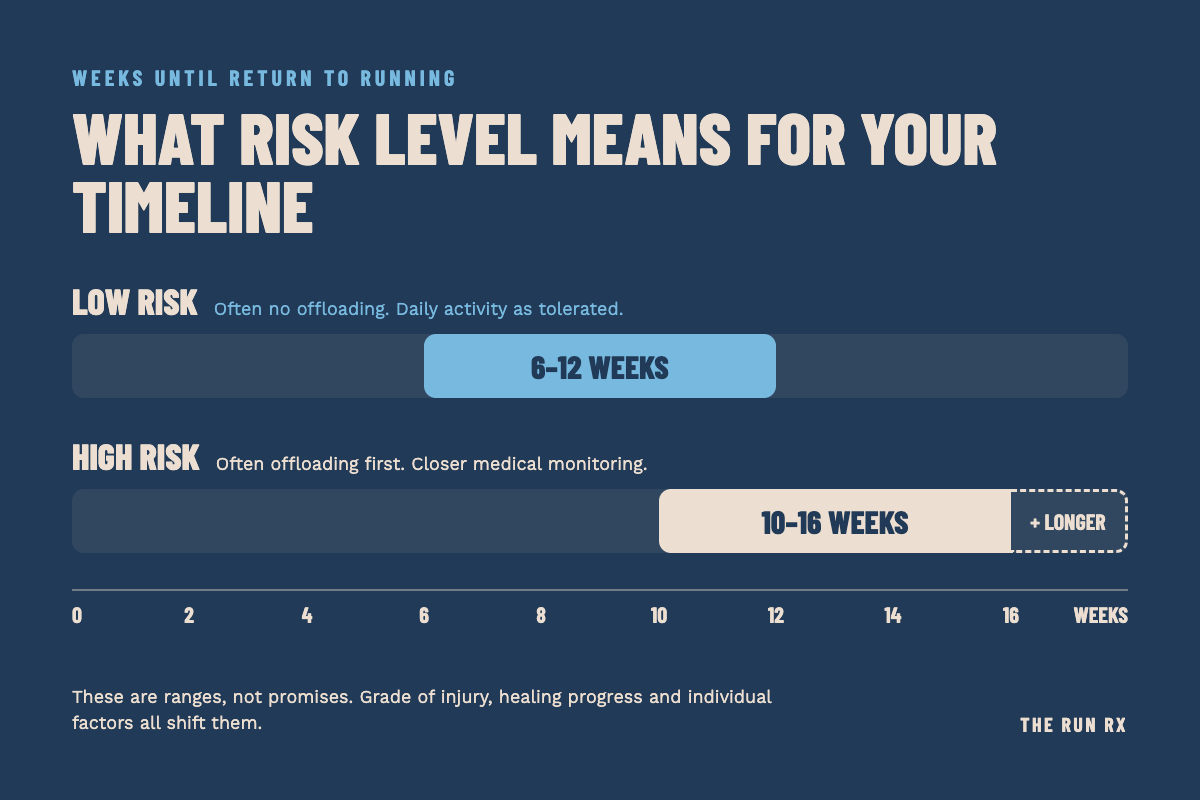
High risk often means a period of non-weightbearing or day-to-day offloading, closer medical monitoring, and roughly 10-16 weeks before returning to running — sometimes longer.
Low risk often requires no offloading at all, with daily activity as tolerated, and more commonly a 6-12 week window off running
These are ranges, not promises. Grade of injury, healing progress, and individual factors all shift them.
Where it happened also hints at why
There's a second pattern, and it shapes the plan rather than just the timeline.
More central/proximal sites — sacrum, pelvis, femoral neck — are packed with trabecular ("spongy") bone. That tissue is more metabolically active and more sensitive to fueling and hormone status. Female athletes with a bone stress injury in a spongy location have shown a 3.3x increased risk of low bone mineral density.
More distal sites — tibial shaft, metatarsals — are cortical-rich. Denser, less metabolically reactive, and more often mechanical in origin: a training spike, a surface change, new shoes, a deliberate gait change.
Picture two runners.
A postpartum runner develops a sacral stress injury while rebuilding mileage through major hormonal change. A well-fueled runner jumps volume 40% while switching to a forefoot strike, and develops a metatarsal injury.
Same diagnosis. But the first question you'd want answered is completely different — and so is who else belongs in the plan. One needs a fueling and hormone conversation, often with a sports dietitian and physician, running alongside rehab from day one. The other may need a hard look at training load, footwear, and mechanics first.
One important caveat: virtually every bone stress injury is multifactorial. Distal injuries can absolutely involve under-fueling. Proximal ones can absolutely involve a training error.
Location doesn't diagnose the cause. It tells you where to look hardest first.
Why this matters for the conversation you're having
Most runners come to us with an imaging report and not much else. They know they have "a stress fracture" — but not which surface of the bone, not whether it's high or low risk, and not why the timeline they were quoted is what it is.
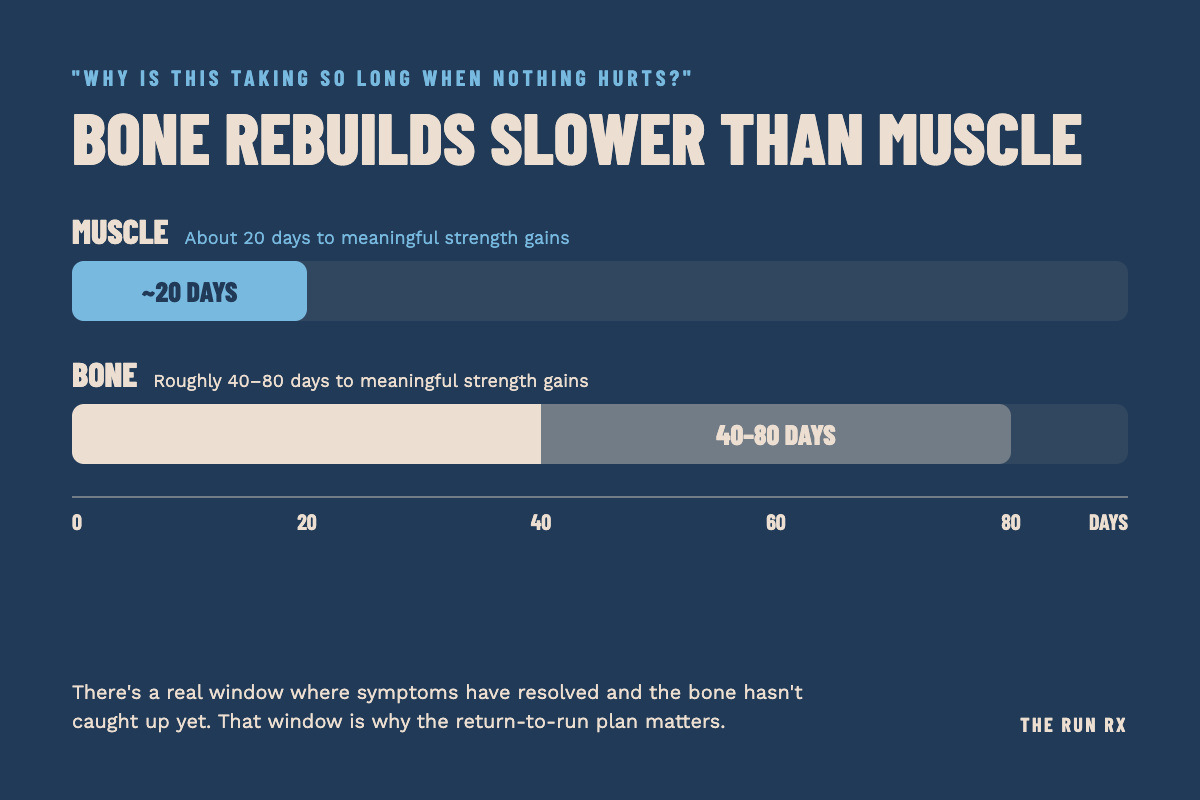
It leaves runners without the piece that explains everything else — which is why "why is this taking so long when nothing hurts?" is one of the most common questions we get.
Knowing your specific site changes:
Whether you should be offloading
How much the surrounding tissue can be loaded early
What benchmarks have to be met before running
Who else should be part of the plan
If you were given a diagnosis without much detail, it's worth asking — or worth having someone read the imaging report with you and translate what it means for your return.
Recovering from a bone stress injury and unsure what your timeline should actually look like? The Run Rx in Somerville provides running-specific physical therapy, bone stress injury rehab, and structured return-to-run programming for runners across Boston, Cambridge, and Medford.

FAQ’s
What makes a bone stress injury "high risk"?
Poor blood supply to that site, and whether the forces there pull the bone apart (tension) rather than press it together (compression). High-risk sites like the femoral neck, navicular, and anterior tibia are prone to delayed or failed healing and usually require offloading.
Why is an anterior tibial stress fracture worse than a posteromedial one?
The anterior tibia is the tension side, so the forces running through it work against the fracture site closing. Healing can take up to 20 months, versus a typically straightforward recovery posteromedially.
How long does a stress fracture take to heal in a runner?
It depends heavily on the site. Low-risk injuries commonly fall in the 6-12 week range. High-risk injuries more often run 10-16 weeks or longer, frequently with offloading first.
Does the location of my stress injury say anything about the cause?
It shifts the odds. Central sites like the sacrum and pelvis are more sensitive to fueling and hormone status. Distal sites like the tibia and metatarsals skew mechanical — training spikes, surface or shoe changes, gait changes. Most injuries involve both.
Why does recovery feel so long when I'm not in pain anymore?
Bone rebuilds slower than muscle — roughly 40-80 days to show meaningful strength gains, versus about 20 for muscle. There's a real window where symptoms have resolved and the bone hasn't caught up.
My doctor didn't tell me which part of the bone was injured. Does it matter?
It can matter a lot. The same bone can produce a low-risk injury on one surface and a high-risk one on another, with very different offloading requirements and timelines. Worth asking about, or having reviewed alongside your imaging.
Somerville, MA