How Runners Actually Build Stronger Bones (Hint: It Isn't Running)

Running is a high-impact sport, so it should build strong bones. That's the assumption almost every runner makes — and it's wrong.
Running sits in an unfortunate middle ground: enough repetitive load to break bone down, not the kind of load that builds it back up. That gap is a big part of why bone stress injuries are so common in running and comparatively rare in sports with similar or higher impact.
Here's what bone actually responds to, and how to give it that.
What bone actually responds to
Bone is living tissue. It remodels constantly, adding material where it's stressed and removing it where it isn't. But it's picky about what counts as a signal.
Research on bone strengthening adaptation points to 4 things bone responds to:
High strain magnitude — genuinely high forces/impacts
High strain rate — forces applied fast
Unusual or unbalanced load distribution — variety, not the same direction over and over
Recovery periods between loading
Look at that list, then think about a steady 6-mile run.
Moderate forces. Applied relatively slowly. In the same direction, over and over, for thousands of cycles. With essentially no rest between them.
Now picture a basketball player planting hard off one leg to explode to the rim. Huge force. Delivered in a fraction of a second. From an angle their body doesn't see every day. Then they slide laterally to defend, get the rest of timeouts and stoppages, and do it again later.
Distance running is close to the opposite of what bone wants on every variable.
The part that surprises people: more isn't better
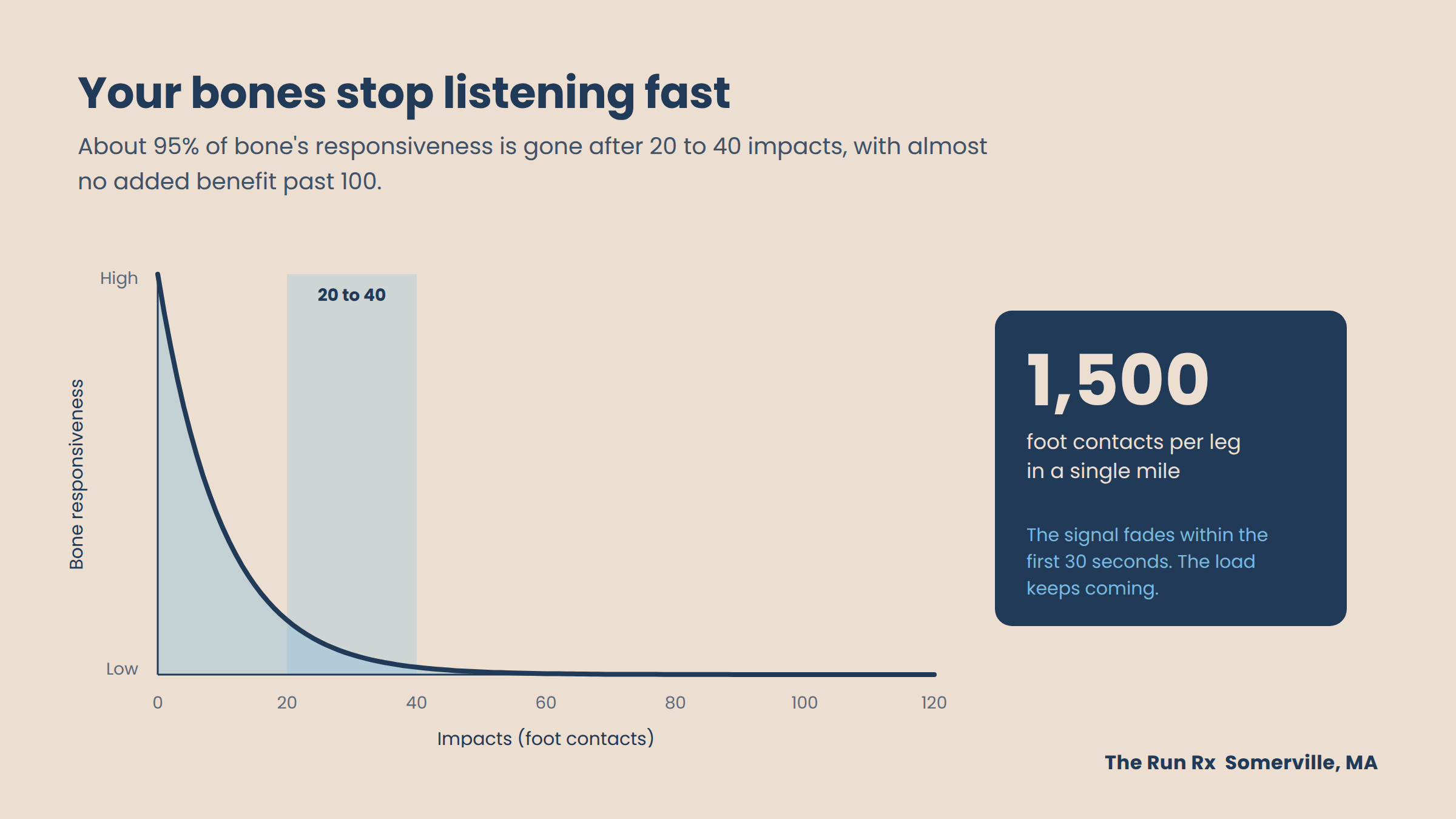
Bone doesn't respond to load in a linear way. It gets desensitized, and fast. Roughly 95% of bone's mechanosensitivity (or response to stimulus) is dampened after only 20-40 impacts, with almost no measurable benefit beyond about 100.
A single mile is around 1,500 foot contacts per leg.
So somewhere in the first 30 seconds of your run, your bones have largely stopped listening. Everything after that is accumulating load without the positive adaptation.
That's the perfect storm. The repetitive impacts that break bone down keep coming long after the signal that would build it up has switched off.
What actually rebuilds sensitivity: rest
The flip side is genuinely useful. Rest periods as short as 15 seconds-4 hours have been shown to increase bone formation outcomes by 65-100%, with about 98% of mechanosensitivity restored roughly 24 hours after a loading event.
This is why bone-loading work should be dosed in short sets with rest, not long continuous efforts. A few high-quality, high-load plyometrics, rest, repeat — that's a good bone stimulus. 30 more minutes of running is not.
Bone and tendon want opposite things
This trips up a lot of well-intentioned strength programs.
Tendon adapts best to slow, heavy load. Long time under tension, controlled tempo, high force.
Bone adapts best to fast, high-rate load. Impact, speed, quick ground contacts — the exact opposite end of the spectrum.
Both matter. But if a runner's program is entirely slow heavy lifting (or worse, not heavy enough lifting), they may be building excellent tendon capacity while giving bone almost nothing it recognizes as a signal.
Not all plyometrics are bone-building plyometrics
This is where good intentions often stop short.
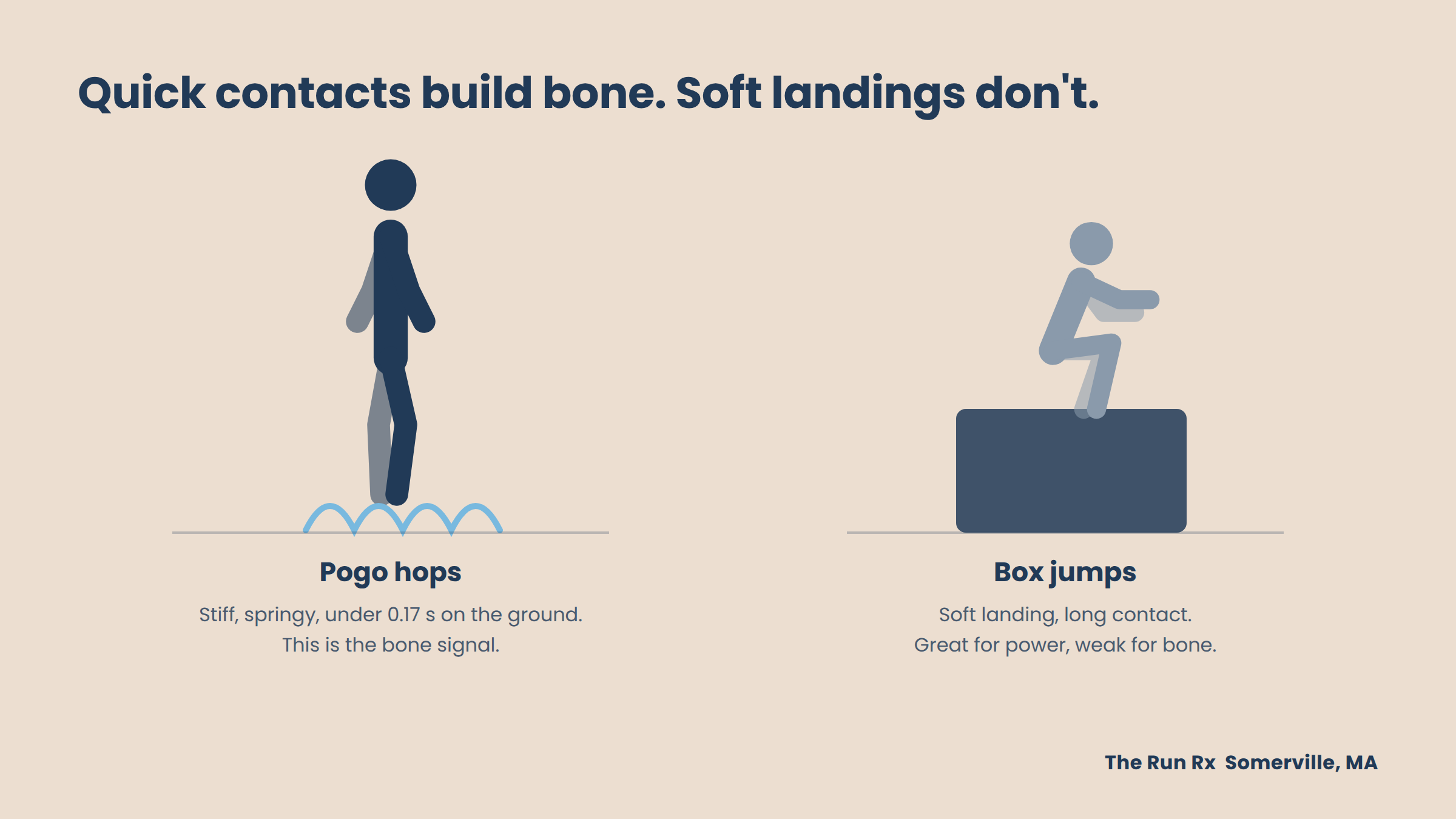
Plyometrics is a broad category, and not every jump delivers what bone is looking for. Box jumps are a plyometric movement, and they're genuinely useful for strength and power — but the landing is soft, the ground contact is long, and the force arrives relatively slowly. That's not the profile bone responds to.
What bone wants is short, stiff, fast ground contact. Think quick pogo hops — up and down, then lateral, then forward and back — so the force arrives fast and from varied directions. Ground contact times under roughly 0.17 seconds are the target. The goal isn't fatigue. It's reactivity.
Why timing matters more than most people realize
Because bone desensitizes so quickly, when you do plyometrics may change how much it's worth.
If you jog for 10 minutes and then do plyometrics, you've spent a good portion of your bone's responsiveness on the jog. The same jumps done on fresh legs, before you run, land on a fully sensitized system ready for bone stimulation.
In practice, it's often why we dose plyometrics into the warm-up rather than tacking them onto a strength session at the end of the day.
Why rehab continues after the pain is gone
If you've had a bone stress injury, this is the single most common place runners get burned, and the timeline explains why.
When you stop loading, muscle loses size and strength within 5-7 days. Bone takes 14-21 days to show meaningful loss.
But the rebuild is even more lopsided. Muscle shows significant gains around 20 days. Bone takes 40-80 days.
Bone is slower to lose and much slower to rebuild. So there's a window — often weeks long — where you feel fine, your muscles have come back, walking is painless, and your bone has not caught up.
Pain resolving means the symptom resolved. It does not mean the bone is back to full health.
That window is what a structured protocol is for: progressively loading the injured site with bone-stimulating work and plyometrics until the bone has a reason to rebuild — then returning to running in a measured, progressive way. Skipping it is how a first bone stress injury becomes a second one (or an unhealed one)
Why this is hard to get right on your own
The principles above are simple to state and genuinely difficult to apply well, because the right dose depends on things a generic protocol can't see.
Which bone was injured, and whether it's a site that tolerates loading early or needs protecting. Where you are in healing stage. What your ankle and foot can currently tolerate. Whether your landing mechanics are quietly shying away from the injured side — a common pattern that makes a jump look fine while delivering the stimulus somewhere else entirely. And how the bone work fits alongside your running, lifting, and life so you're not stacking too much load beyond between life, exercises and running
This is a large part of why we prefer to see runners in person for bone stress injury rehab whenever we can — watching how you actually load, testing benchmarks rather than counting weeks, and adjusting the dose as you progress. The same applies preventively: if you've never had a BSI but you're running high volume, a short, well-dosed bone-loading program is one of the higher-return additions you can make to a training week.
Coming back from a bone stress injury, or want to build a skeleton that holds up to your mileage? The Run Rx in Somerville provides running-specific physical therapy, bone stress injury rehab, and structured return-to-run programming for runners across Boston, Cambridge, and Medford.
FAQ
Does running build bone density?
Not particularly well. Bone responds to high-magnitude, fast, varied loading with rest between efforts. Distance running provides moderate, slow, repetitive loading with no rest — and bone's responsiveness drops roughly 95% after only 20-40 loading cycles. Running accumulates damage far longer than it accumulates adaptation.
What exercises actually build bone for runners?
Fast, reactive, short-ground-contact plyometrics — quick pogo hops performed vertically, laterally, and forward/back. Dosed in short sets with real rest, not long continuous bouts. Heavy lifting matters for tendon and muscle but delivers relatively little bone stimulus on its own.
Are box jumps good for bone health?
They're useful for power and strength, but they're not an efficient bone stimulus. The landing is soft and the ground contact is long, so force arrives slowly. Bone responds to how fast load arrives, not how high you jump.
Should I do plyometrics before or after running?
Before, in most cases. Bone desensitizes to loading very quickly, so jumping on fresh legs delivers a stronger stimulus than jumping after a run has already used up much of that responsiveness.
How many jumps do I actually need?
Fewer than most people expect. Bone's response largely saturates after 20-40 loading cycles, so short sets with rest between them outperform high-volume jumping. Starting conservatively and building gradually matters more than accumulating reps.
Do I still need physical therapy if my bone stress injury doesn't hurt anymore?
Yes. Bone takes 40-80 days of loading to show meaningful strength gains, while muscle takes about 20. There's a long window where you feel fine and the bone hasn't caught up. Structured, progressive loading during that window is what reduces reinjury risk.
Can I do bone-loading work if I've never had a stress injury?
Yes, and it's one of the better preventive additions to a running program. The dosing principles are the same — short sets, fast contacts, real rest, fresh legs — starting around 20 ground contacts per foot and building gradually.
Somerville, MA