Cadence, stride length, and foot strike are not three separate things you can fix independently. They're mechanically linked — change one, and the other two move whether you meant them to or not. That's why "just increase your cadence" so often doesn't do what runners expect.
This comes up in nearly every gait analysis we run at our Boston-area clinic — usually with a runner who's already tried the watch-metric fix and is still hurting.
What each one actually is
Cadence — steps per minute
Stride length — how far your foot reaches out in front of you before it lands
Foot strike — where your foot lands (heel, midfoot, forefoot)
Three readouts. One system.
It's not about how long — it's about where you land
This is the distinction that matters most, and it's where most runners get tripped up.
Reaching isn't automatically a problem. What matters is where your foot lands relative to your body.
Overstriding is when the foot lands well ahead of your center of mass, usually with a relatively straight knee and the leg reaching out rather than falling underneath you.
A quick reference point: at contact, your foot should sit roughly under or just slightly behind your knee and draw a vertical line up from your ankle, the line should land somewhere within your pelvis, not out in front of it.
Why a straight knee at landing is the real issue
Your knee reaches a peak of about 45° of bend at midstance phase (shortly after contact when you've fully accepted weight on that leg) and some of that bend should already be there the moment you strike the ground.
Think about jumping off a curb. You don't land with locked legs — you land already slightly bent, then bend further to absorb it. Running is the same thing, just smaller and repeated a thousand times a mile.
A knee that arrives at the ground nearly straight has no room left to absorb what's coming.
When you land far ahead of your body, you lose the ability to absorb impact through eccentric muscle work. That load doesn't disappear — it gets handed off to your passive structures: bone, cartilage, tendons, ligaments.
The numbers back this up. As the foot lands closer to the body, the estimated probability of tibial stress fracture drops by roughly 3-6% per meaningful reduction in stride length.
How foot strike gets pulled into it
A runner with a low cadence and a long reach is very likely a heel striker — not because their form is "bad," but because it's mechanically hard to land forefoot-first when your foot is out in front of you.
Land closer to your body and a midfoot or forefoot strike becomes more available.
But here's the part people miss: about 80% of distance runners heel strike anyway, regardless of stride length. We see this constantly in our Somerville clinic — runners who've spent months trying to force a forefoot landing, only to find it disappears the moment they stop thinking about it. Foot strike is usually a downstream expression of what's happening above the foot — not a technique choice.
One more telling detail: most runners drift back toward a heel strike as they fatigue, regardless of how they started. That's not form falling apart. That's your body making its own load-management decision once capacity runs low.
Does foot strike actually matter for injury?
Yes — but not the way it gets talked about online.
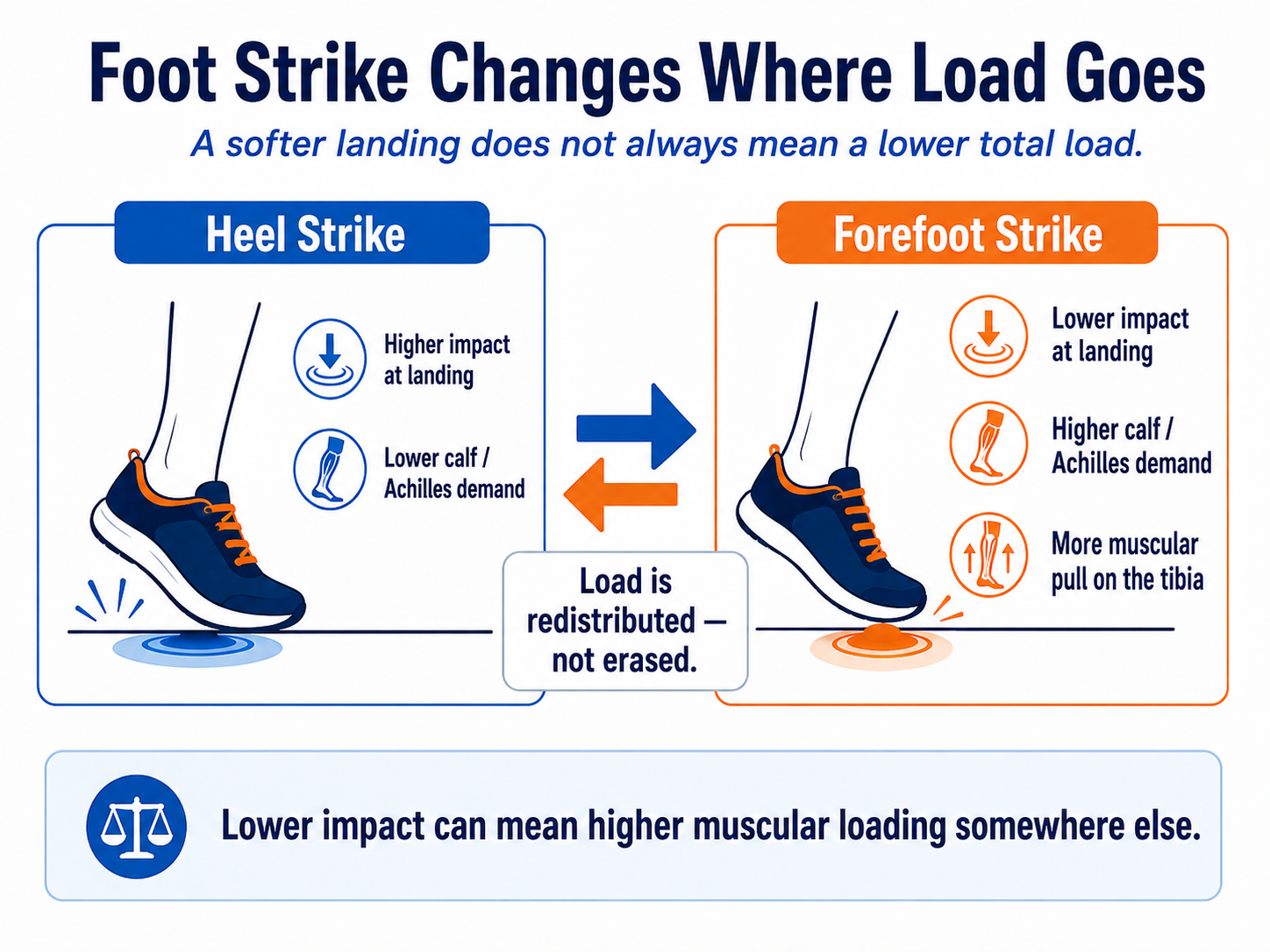
Forefoot striking does lower vertical impact at landing. That's the stat everyone quotes.
What gets left out:
Your shin bone (tibia) takes on roughly 9x your body weight in forces when you run. The impact of hitting the ground accounts for only about a 25% of that. The remainder of those forces come from your own muscles — every your muscles contract, they pull on that same bone.
Forefoot striking significantly increases calf and Achilles demand which increases the muscular pull on that same tibia.
So a "softer" landing can come with a heavier bone-loading bill somewhere else. Lower impact doesn't always mean lower risk. It usually means the load moved elsewhere.
Why a shorter stride feels harder at first
If you shorten your stride and it feels like more work — that's expected.
You're asking your muscles and tendons to do work that a longer, more extended landing was offloading onto passive structures. Active work costs energy. Passing it off to your “passive” structures (those that don’t contract) doesn’t require energy but these structures then take more of a beating.
This is exactly why plyometrics belong in a runner's program. They build the stretch-shortening cycle efficiency that makes a shorter, quicker stride sustainable rather than exhausting.
So should you change anything?
Sometimes, yes. We're not against gait retraining — we're against doing it blindly.
Foot strike is rarely where we start. It's the most disruptive change, it pushes load onto tissues that may not be ready for it, and it usually shifts on its own when the things above it improve.
Reducing how far you reach out in front of you is a different story. It's one of the lower-risk changes available, and there's real evidence behind it — less braking force, less demand on passive structures, lower estimated bone stress risk.
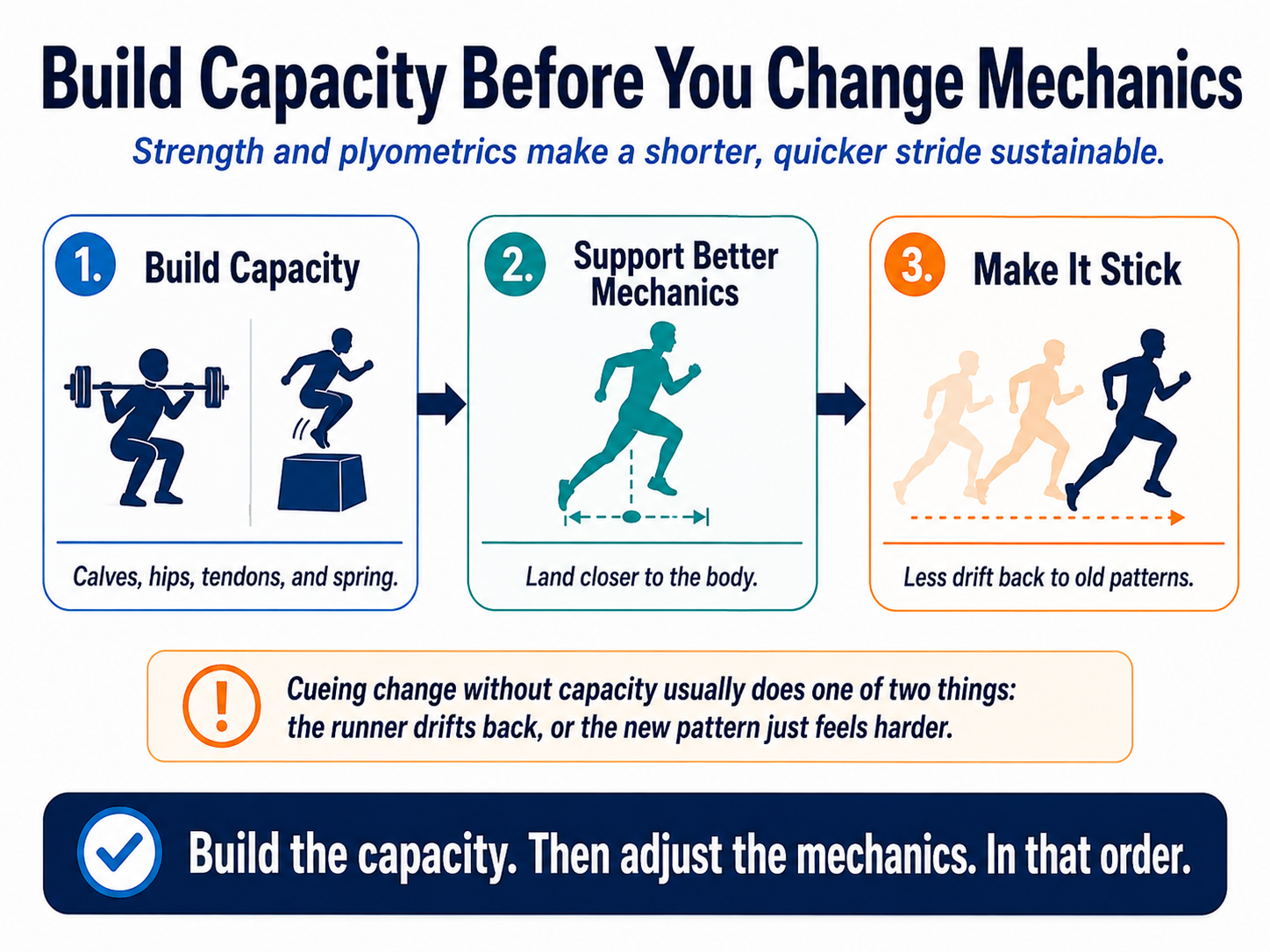
But here's the part that gets skipped: landing closer to your body only holds if you've built the capacity to sustain it. A shorter, quicker stride asks more of your muscles and tendons than a long reaching one does — that's exactly why it protects your bones, and exactly why it feels harder at first.
Cue it without that foundation and one of two things happens. You drift back to your old pattern within a mile. Or you hold the new one but it feels harder.
This is why strength work and plyometrics aren't the boring prerequisite before the "real" fix. They're what makes the change stick.
Build the capacity. Then adjust the mechanics. In that order.
Dealing with a recurring running injury in Boston, or curious what your gait is actually doing? The Run Rx in Somerville provides running-specific physical therapy, gait analysis, and return-to-run programming for runners across Boston, Cambridge, and Medford. Schedule an evaluation
FAQ
Is a lower cadence bad for runners? Not inherently — cadence is individual, shaped by height, speed, and effort. That said, prospective research has linked notably low cadence to higher bone stress injury risk in some runner populations.
Is forefoot striking better than heel striking? Neither is universally better. Forefoot striking lowers impact at landing but raises calf, Achilles, and tibial muscular loading. The right pattern depends on your history, strength, and injury pattern.
Should I try to change my foot strike to prevent injury? Not without guidance. Changing foot strike redistributes load rather than removing it. Transitioning without adequate calf and Achilles capacity is a common route to new injuries.
Can my shoes be causing me to overstride? Possibly. An elevated heel lets you land with a more extended leg further ahead of your body without the sensory feedback that would normally discourage it.
Do I need a gait analysis to know any of this? Not necessarily — but it's the fastest way to see what your specific pattern is doing, rather than guessing from a watch metric.