

A running gait analysis provides far more insight than what the eye can see. While slow-motion video is an important part of evaluating running mechanics, it doesn’t tell the whole story.
At Run Rx, we combine high-speed video with Runeasi sensor technology to objectively measure how your body moves while running. This allows us to identify subtle movement patterns linked to running injuries, inefficiency, and performance limitations that may not be visible on video alone.
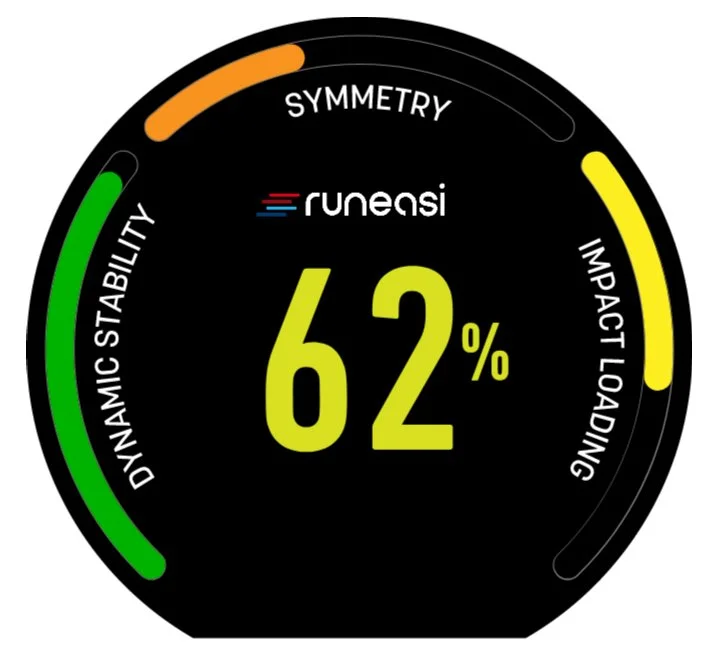
The Runeasi sensor provides a running quality score, which we use as an injury-risk snapshot. This score is based on three primary components:
Dynamic stability
Impact loading
Symmetry
Understanding these metrics helps us build a treatment and training plan that is specific to your body and your goals.
Dynamic Stability: Pelvic Control During Running
Dynamic stability measures how steady your pelvis is while you run. The Runeasi sensor is worn on a belt around the pelvis and detects movement in multiple directions.
Some pelvic motion is productive, such as:
Vertical (up and down)
Forward and backward movement
Other motion is considered unproductive, including:
Excessive side-to-side motion
Rotational wobbling
The sensor calculates the percentage of movement that falls into this unproductive category.

Why Dynamic Stability Matters for Runners
1. Running Efficiency
Excessive pelvic motion wastes energy. The more energy that is directed forward instead of side-to-side, the more efficient your running becomes.
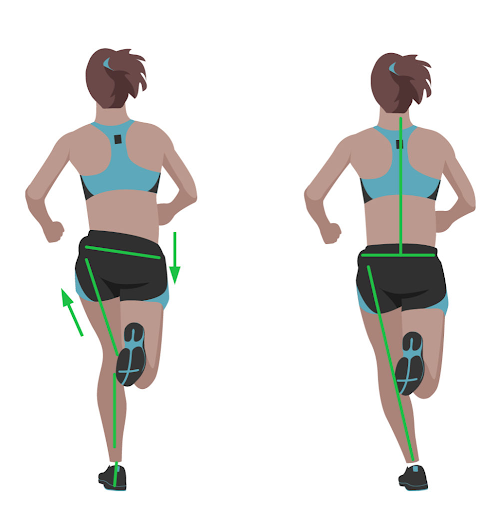
2. Injury Risk
Poor dynamic stability can lead to a chain reaction throughout the body, including:
Increased lumbar extension, contributing to low back pain
Hip, knee, ankle, or foot collapse
Pelvic drop, resulting in harder landings and higher impact forces
How We Improve Dynamic Stability
Interventions depend on the individual runner but often include:
Single-leg stability and strength exercises
Core, hip, and glute strengthening
Foot intrinsic muscle strengthening
Mobility work, especially hip extension
Fatigue-resistant training, since instability often increases with endurance demands
Impact Loading: How Your Body Absorbs Force
Impact loading describes how your body meets the ground and absorbs shock with each step. It is made up of two components: impact magnitude and impact duration.
Impact Magnitude: How Hard You Hit the Ground
Impact magnitude is measured in g-forces and reflects how quickly your body decelerates at initial contact. Factors that influence impact magnitude include:
Foot strike location relative to center of mass
Leg stiffness at contact
Running speed
Gait “bounce”
Shoe selection
Terrain (downhill running increases impact forces)
In simple terms: If your big toe can’t extend or load well, you’re leaving power on the table.
For runners training for Boston-area races — from local road races to the Boston Marathon — small inefficiencies like this add up quickly over high mileage athletes.
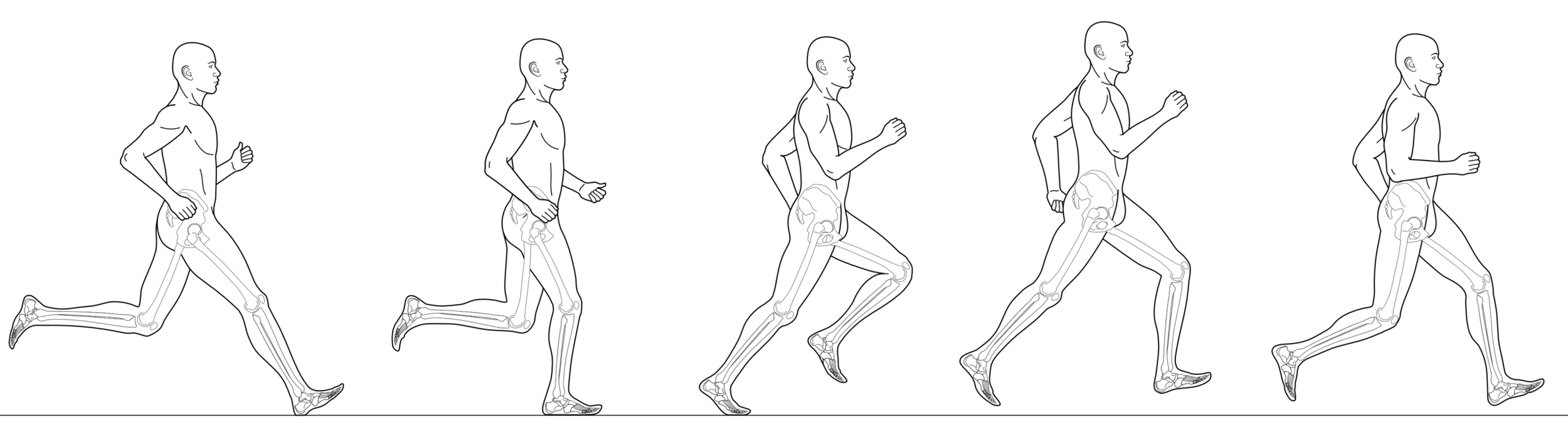
Impact Duration: How Well You Absorb Force
Impact duration measures how quickly landing forces are transmitted through the body. A useful analogy is braking in a car:
Slamming the brakes results in a rapid, jarring force transfer
Gradual braking spreads the force over a longer period of time
Longer impact duration indicates better shock absorption and lower injury risk.
Factors that influence impact duration include:
Foot and ankle mobility
Lower-leg and quadriceps strength
Coordination and timing of muscle activation
In general:
Lower impact magnitude is better
Longer impact duration is better
Improving impact duration often leads to lower impact magnitude, reducing overall stress on the musculoskeletal system.
How We Improve Impact Loading
Based on your gait analysis findings, interventions may include:
Mobility work
Strength training
Gait retraining strategies
Plyometric training to improve force absorption and efficiency
Symmetry: Comparing Left and Right Leg Mechanics
Symmetry compares how each leg behaves across all gait analysis metrics. Large differences between sides may increase injury risk.
In some cases, asymmetry contributes to injury. In others, it develops as a compensation after pain or injury occurs. Either way, identifying asymmetry is critical for long-term recovery and performance.
How We Improve Running Symmetry
Emphasis on single-leg strength exercises
Equal loading and volume between sides
Progressing strength based on the weaker side’s capacity
Using different weights or repetitions for each leg can sometimes reinforce asymmetry, so we focus on symmetrical progression whenever possible.
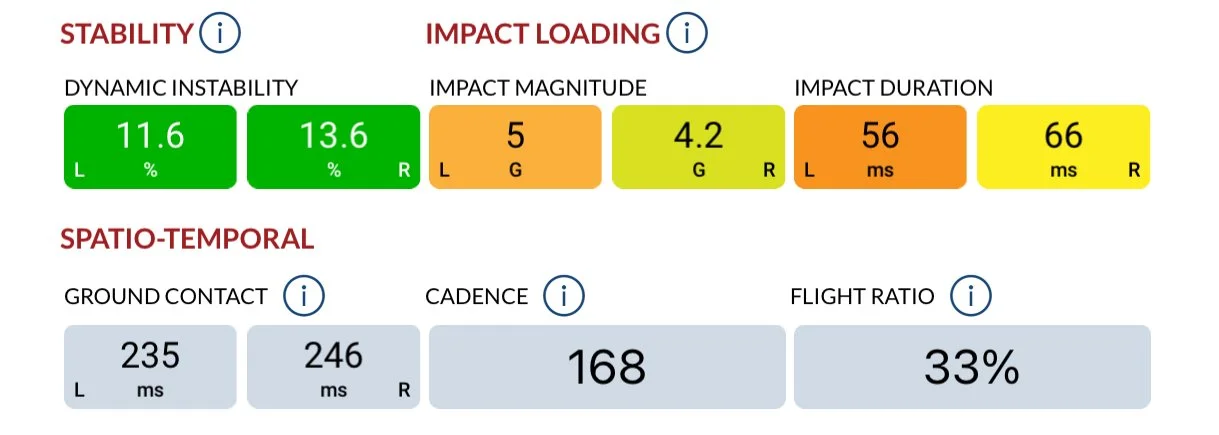
Temporal Metrics: Timing-Based Running Data
The Runeasi sensor also measures temporal metrics, including cadence, ground contact time, and flight ratio. While these values do not contribute to the running quality score, they play an important role in running performance and injury risk.
Cadence
Cadence refers to steps per minute and directly influences running mechanics:Yes. Limited big toe extension can reduce propulsion, disrupt arch stability, and increase stress on the foot, ankle, and knee during running.
At the same speed, increasing cadence shortens step length
At the same step length, increasing cadence increases speed
There is no universal “ideal cadence,” but a slightly higher cadence often:
Reduces overstriding
Improves dynamic stability
Decreases impact forces
Ground Contact Time (GCT)
Ground contact time measures how long each foot stays on the ground during a stride. Most recreational and competitive runners fall around 250 milliseconds or less per leg. Shorter ground contact time is generally associated with improved stability and efficiency.
Flight Ratio (Duty Factor)
Flight ratio describes the percentage of time spent in the air while running:
Typical range: 33–36%
Higher values indicate a more aerial running style
Lower values reflect a more grounded running pattern
Higher flight ratios are often associated with stiffer landings and increased impact magnitude.
How Temporal Metrics Interact
Cadence, ground contact time, and flight ratio are closely linked. For example, a high flight ratio often corresponds with:
Reduced ground contact time
Stiffer landings
Increased impact forces
How We Improve Temporal Metrics

We rarely target ground contact time or flight ratio directly. Instead, we typically:
Increase cadence by approximately 5–10%
Improve leg and tendon stiffness through strength training
Add plyometric exercises to enhance elastic energy return
Why Sensor-Based Running Gait Analysis Matters
Dynamic stability, impact loading, symmetry, and temporal metrics do not exist in isolation. They interact to influence how efficiently you run and how much stress your body absorbs with every step.
By combining Runeasi sensor data, slow-motion video analysis, and your individual goals, we can create a personalized treatment or training plan designed to:
Reduce injury risk
Improve running efficiency
Support long-term performance and durability
If you’re curious about what your running gait analysis data looks like, we’d love to walk through it with you.

Somerville, MA