

Why Plyometric Training Improves Running Economy for Runners
When distance runners think about improving performance, the focus usually falls on mileage, structured workouts, and aerobic fitness. Strength training—and especially plyometric training for runners—is often viewed as optional.
However, modern biomechanics and sports science research suggest that plyometric training can play an important role in improving running economy and efficiency, even for long-distance runners.
At our runner-focused physical therapy and performance clinic serving Boston and Somerville, we frequently see runners improve efficiency and durability when strength and plyometric training are integrated into their program.
Importantly, the value of plyometrics has less to do with building raw power and more to do with how the body stores, transfers, and reuses energy during running.
Muscles Are Slow—Running Is Not
At the level of individual muscle fibers, muscles shorten relatively slowly. Because of the force–velocity relationship, a muscle’s ability to produce force decreases as contraction speed increases.
This creates a challenge for running.
Running requires relatively high forces applied during extremely short ground contact times, even at moderate paces.
Biomechanical research shows that muscles alone cannot generate the power required for running at faster speeds. Instead, a significant portion of the work comes from elastic tissues—primarily tendons.
Tendons Play a Major Role in Running Economy
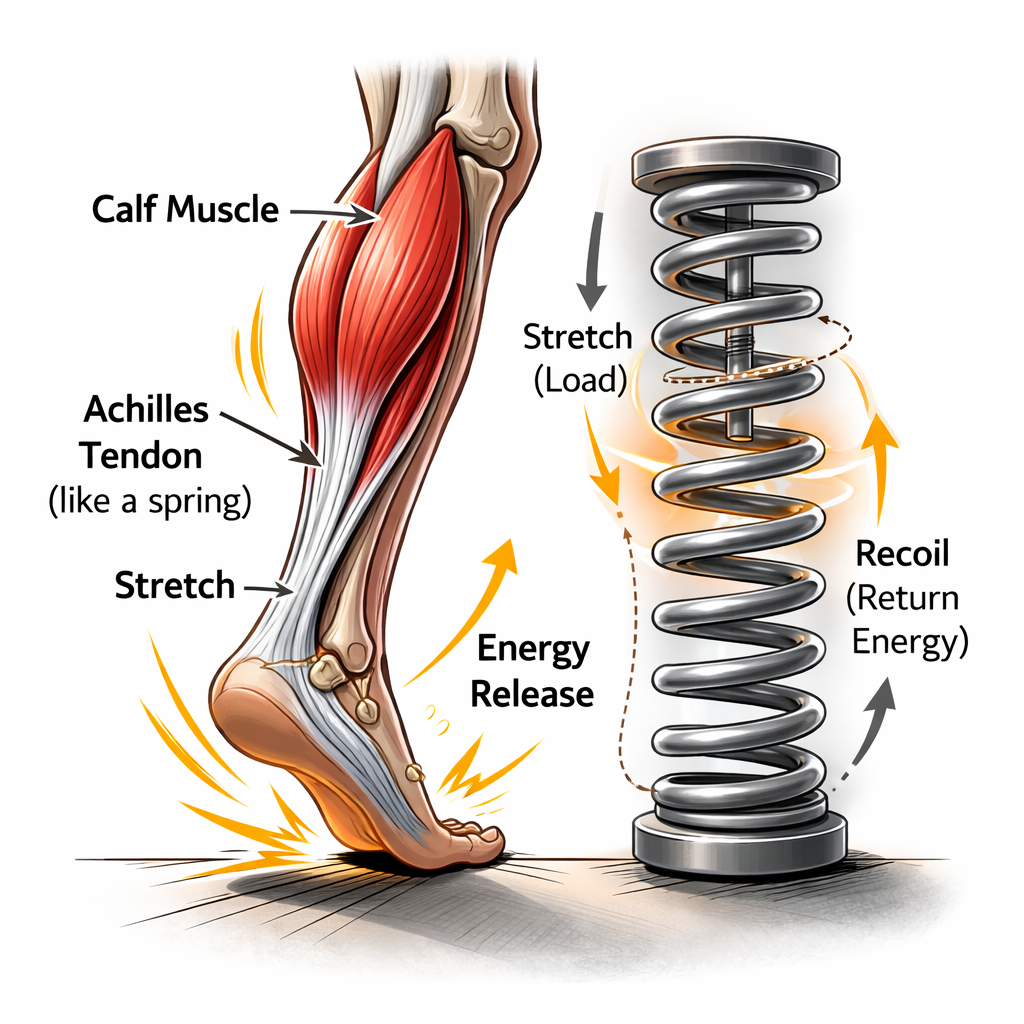
Rather than shortening rapidly, muscles—especially the calf muscles—often act in a near-isometric manner during running. This allows them to generate force while stretching the tendon.
The tendon then recoils and returns energy during push-off.
Runners with better running economy consistently demonstrate:
Stiffer Achilles tendons
Reduced energy loss during tendon stretch and recoil
More effective use of elastic energy
As a result, these runners can maintain the same pace with lower oxygen consumption and less muscular effort.
In distance running, research suggests that approximately 50% of the energy used per stride comes from elastic energy stored and released by tendons, particularly the Achilles tendon and structures within the foot.
What Plyometric Training Does for Distance Runners
Plyometric training involves fast, explosive movements that use the stretch-shortening cycle (SSC)—a rapid stretch followed immediately by contraction.
For distance runners, the goal of plyometrics is not to jump higher or produce maximal power.
Instead, plyometrics improve how the muscle–tendon system behaves during repetitive ground contacts, which closely mirrors the demands of running.
Research shows plyometric training can:
Improve elastic energy storage and release
Reduce energy loss (hysteresis) in tendons
Increase the ability to apply force quickly
Improve coordination between muscles and tendons
In practical terms, plyometrics help tendons behave more like efficient springs, which is essential for economical running over long distances.

Strength Training vs Plyometrics: Why Both Matter for Runners
Heavy strength training is one of the most effective methods for increasing tendon stiffness, a quality strongly associated with improved running economy.
Research shows that heavy lower-body strength training can reduce oxygen cost and improve endurance performance in trained runners.
Plyometric training, while having a smaller direct effect on tendon stiffness, plays an important complementary role.
Plyometrics help runners:
Use tendon stiffness effectively at running speeds
Improve tendon recoil during short ground contact times
Enhance neuromuscular coordination during dynamic movement
In simple terms:
Strength training builds capacity.
Plyometric training improves function.
For distance runners, combining strength training and plyometrics leads to the greatest improvements in efficiency and performance.
Why Plyometrics Improve Running Efficiency Even at Easy Paces
Although plyometric exercises involve fast movements, their adaptations carry over to steady-state running speeds.
Improved tendon behavior leads to:
Less muscular work required per stride
Reduced fatigue accumulation during long runs
Improved efficiency across a wide range of running speeds
This helps explain why runners with stiffer, well-functioning tendons consistently demonstrate superior running economy, even when aerobic fitness is similar.

Key Takeaways for Distance Runners
Running performance depends heavily on elastic energy reuse, not just aerobic capacity
Tendons—especially the Achilles tendon—play a central role in running economy
Plyometric training improves how tendons store and release energy
Strength training increases tendon stiffness, while plyometrics improve how that stiffness is used
Combining strength and plyometric training helps runners become more efficient and resilient
For long-distance runners, plyometric training is not about becoming more explosive.
It is about becoming more economical with every stride.
How The Run Rx Helps Runners Train Smarter
At The Run Rx in Somerville, we work with runners from across Boston, Cambridge, and the Greater Boston area to improve running economy, reduce injury risk, and build durable strength.
Using 1-on-1 runner-focused physical therapy, strength programming, and advanced gait analysis, we identify where efficiency is being lost and help runners build the strength and tendon function needed to support high mileage and race performance.
Whether you're training for the Boston Marathon or simply want to run more efficiently and stay injury-resilient, our goal is simple: help you move better and keep running for the long haul.
PLYOMETRIC FAQ’S
Do plyometrics improve running economy?
Yes. Plyometric training improves how tendons store and release elastic energy during running, allowing runners to maintain pace with lower oxygen cost and reduced muscular effort.
Are plyometrics useful for distance runners?
Yes. Plyometrics help distance runners improve tendon efficiency, coordination, and force application during short ground contact times, all of which improve running economy.
How often should runners do plyometric training?
Most runners benefit from 1–2 plyometric sessions per week, typically integrated with strength training or after easy runs.

Somerville, MA
